How I lost more than 35 pounds…twice
The story of how Chris took command of his weight loss

What’s up guys! This is a new dimension of Pointman that I’m really excited about. In this series I will be featuring stories of our readers taking command of their health and vitality in really big ways.
To kick this off, I’m happy to present the story of Chris McCarthy. He is one of my best friends and one of the original sounding boards for Pointman. He’s also a writer, so you’re in for a treat.
Recently he dropped a shit ton of weight and got rid of his dad bod, but what makes his story particularly interesting is that he did it twice. What’s most amazing to me is that in this past cycle almost all of the weight he lost was fat, not muscle. He retained 98.8% of his starting muscle mass! In this story below, he shows you exactly how he did it.
I want to say thanks in advance to Chris for sharing. Be sure to see the end where I discuss the big lessons we can all learn. If you have a story like Chris and want to share here on Pointman, please do hit me up.
Enter Chris

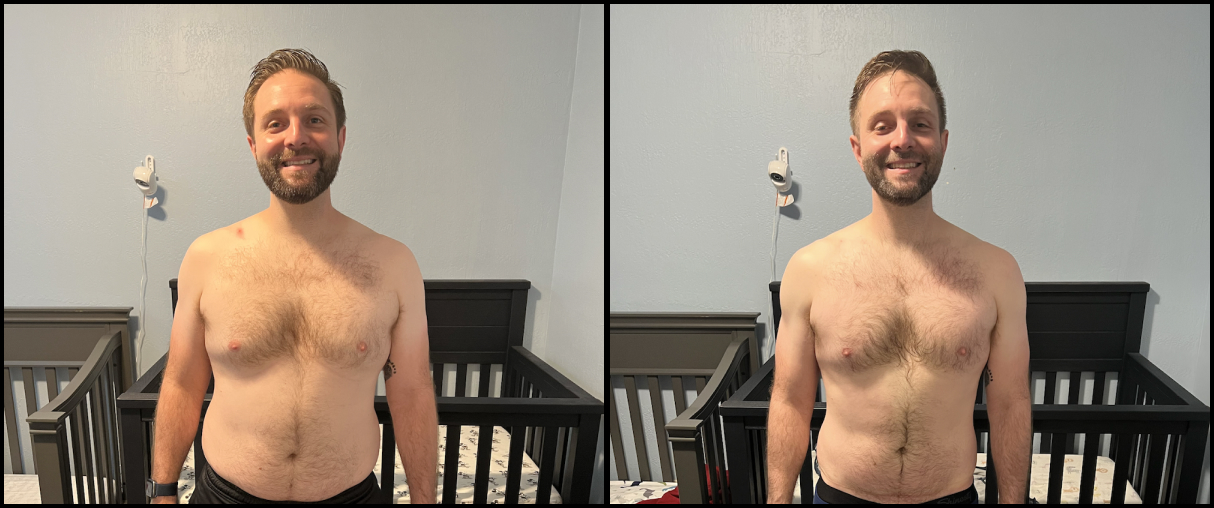
This is me in December, 2017 - 5’9in, 220-ish lbs. I was a beefy boi. My perspective on weight is that if you’re healthy and comfortable with yourself and how you look, then who cares? Do your thing! We’re not here to body-shame.
However, in my case, I wasn’t happy or comfortable with my body. My clothes didn’t fit, I didn’t feel great, and my stomach jiggled when I brushed my teeth.
Long story short, I started a program through a company called Enara Health in June 2018, and lost over 50 lbs in 3 months by partaking in a VLCD (very low calorie diet) where I consumed only 800 calories a day.
Then the world shut down in 2020. I decided that the stress of covid, work, and taking care of my son (now 2 sons, and both are maniacs) was enough - and didn’t want to worry about my weight too. I sought out comfort foods, drank plenty of beer, and just generally didn’t take care of myself in the way I know I should. In around a year and a half, I went from a studly 170 to just over 202.
So I recently hopped back on the program, and for the second time I dropped more than 12% body fat in less than 90 days.
Here are the stats
Weight:
- Before 202 pounds
- After 167 pounds
Body Fat:
- Before 31.5%
- After 19.2%
Muscle Mass:
- Before 77 pounds
- After 76.1 pounds
In this post, I’ll cover what I did during those 90 days and why I feel I was successful. Before I do, please note that I’m not a nutritionist or health and fitness expert, and this is just my personal experience; under the wrong circumstances rapid weight loss is dangerous, and I’m not trying to get sued.
So here’s what we’ll cover:
- Mindset
- Support & Resources
- Diet & Nutrition
- Exercise
Mindset
When I joined Enara Health in 2018, I was determined to get fit because none of the methods I’d used in the past really worked. My perspective now is that I could have been successful with any trend or strategy - whether it’s Paleo, Keto, etc - each one operates on the premise of calorie deficits. The real difference in diet strategies is in what food groups are prioritized.
The reason I wasn’t successful with Keto or Paleo was because I didn’t prepare myself mentally. If I didn’t show progress in the time I wanted, I’d say “screw it” and fall back into bad habits.
Here are my tips for getting your mind right for weight loss:
Select a predetermined amount of time to be incredibly strict. Don’t plan on cheat days or cheat meals - go hard for a set amount of time with no exceptions. Time goes by faster than you’d expect.
Create a plan to simplify eating and exercise. We’ll expand on this in the later sections, but having a rough plan on when, what, and how you’ll eat and work out is key. Simplifying things so you don’t have to think too hard will keep you from cheating.
Prepare to eat the same things over and over. One of the best things I’d recommend is finding a couple things you like that fit into your diet plan, and go to town on it.
Prepare to stay home, or get comfortable being the DD - one of the most difficult parts of weight loss for me was the social component. I would be the guy drinking water at the company happy hour, and would have to explain why I’m ordering a small salad at a pizza place. You have to be OK with not participating in everything, at least for a while.
Don’t let the scale discourage you. It’s important to keep track of your progress, but there will be plateaus or even days where you gain weight. Stay the course.
Diligently monitor everything you put in your body. Keep track of your food - take pictures, write it down. You’ll be able to look back and associate your progress with the food you’re eating.
Most importantly, embrace the suck. Rapid weight loss requires drastic changes quickly, and it can be unpleasant. Learn to love it.
Support & Resources
The main benefit of Enara Health is the access to resources, knowledge, and support, and connect you with:
- A licensed nutritionist - they strategize what you should eat, monitor and critique pictures of your meals, and suggest ways to curb hunger and appetite.
- A physician or physician’s assistant - they evaluate your blood work and make sure you’re healthy throughout the VLCD, and can prescribe medication to curb hunger and appetite. (I didn’t take any meds)
- A personal trainer - they work with you to design a strength training regimen that will keep you from losing too much muscle mass while on a caloric deficit.
- Tons of content - they’ve produced guides on what to eat on a VLCD, what to eat at restaurants, trends on obesity and weight gain, studies, etc.
- An app-connected scale
- Genetic nutrition testing
- Metabolic testing
- Body scans
All of the above was super helpful the first time around, but once I understood the nutrition and exercise strategy that worked for me, I ultimately attribute my success to the family and friends who kept me honest and accountable. My wife especially supported me by helping me with cooking healthy meals or giving me shit if I wavered and gravitated towards a cheat meal.
Even though Enara accepts insurance, it’s still expensive, and there are easy substitutes to a few of the services.
- Food trackers like MyFitnessPal. The important part about working with a nutritionist was that they monitored your food to keep you accountable. If you bake logging food into your daily routine, you accomplish the same goal.
- Exercise planners / trackers. If you’re not an experienced weight lifter, there are several apps that give you detailed plans based upon your goals and give you correct form, rep/set counts. I really like SmartGym, which has a premium tier that automatically adjusts existing workouts and suggests new exercises based upon your skill level.
- InBody & Dexafit scans. I found it really helpful to get a baseline of my bodyfat and visceral fat percentages before and after my intense diet. I haven’t used them, but there are a number of companies that offer full body scans that will tell you where you’re at.
- Community. As a Pointman subscriber I doubt I have to elaborate - having a repository of knowledge you can turn to with tips on exercise and nutrition will help get you through your weight loss journey. Be active within your community, ask questions, get real weird with it.
Long story short, don’t go into any diet or lifestyle change thinking you’ll do it alone. I guarantee you have more resources available to you than you think - do a little bit of planning to see what works for you, and take advantage of them.
Diet & Nutrition
The main goal of the VLCD was to eat approximately 800 calories a day, with an important caveat - vegetables don’t count.
The main idea is that vegetables have very low caloric density, so you can eat a literal truckload of them without adding too many calories to your meal. To give you an idea, a single slice of wheat bread is between 100-140 calories, whereas an entire bag of Steamfresh broccoli (3.5 servings) is only 90 calories.
So, what did I eat?
My philosophy on what to eat to lose weight is to make it as simple as humanly possible - because of that, I ate the same things every day, because I knew the exact calorie count and how full they would keep me throughout the day. Here’s almost exactly what I ate and drank for 3 months:
Breakfast - 7:30 AM:
⅓ cup steel cut oatmeal (~140 cal), splash of almond milk (less than 20 cal) and tablespoon of peanut butter (~90 cal).
Lunch - 12:00 PM:

This is still my daily lunch, because it’s easy, quick, and cheap. 2 eggs (70 calories each), 1 slice cheese (70 calories), 1 steamfresh bag of vegetables (does not count).
Dinner - 6:00 PM:
Lean protein of choice - 6 ounces of chicken, 4 ounces of beef, 3 ounces of pork - as long as it’s approximately 200-250 calories. 1 steamfresh bag of vegetables (does not count)
OR
Salad from places like Sweetgreen, substituting dressing for balsamic vinegar.
OR
Burrito bowl from Chipotle, no rice, no guac, no sour cream, extra fajita veggies, extra pico.
Drinks:
1 gallon of water per day. Keeps you hydrated, helps you poop.
Sauces/Dressings/Seasoning:
Anything other than hot-sauce has extra calories. Substitute sauce for seasonings - everything bagel seasoning, Sriracha and Tapatio were my staples.
Desert:
Flavored tea
Helpful but tastes like ass:
Psyllium Husk. A side effect of cutting out foods that are more calorically dense (like carbs/bread) is that you have far less fiber in your diet. Constipation is inevitable. Psyllium husk is a great source of soluble fiber that improves constipation, improves gut health, and does a great job of keeping you full in between meals. 10/10, highly recommend.
What to avoid on the VLCD:
- Sugar and artificial sweeteners. Sugar is calorically dense. Artificial sweeteners might have no calories, but still trigger an insulin response, which means you’re going to get hungry faster than you normally would.
- Fruit. It’s healthy and low in calories, but still high in natural sugars. The insulin response still applies.
- Sauces and dressings - most have extra calories that don’t do anything for you
- Oils - cooking with oils inadvertently adds lots of calories. Substitute olive oil for PAM cooking spray. 0 flavor but 0 calories.
Exercise
An important part of weight loss is muscle mass. The more lean muscle mass you have, the more calories you burn. With that in mind, exercise on a caloric deficit is all about retaining muscle.
I’m not an expert in the science behind this, but my understanding is that while you’re in a deficit, your metabolism eats away at stored calories to make up the difference. Stored calories can come from body fat, or existing muscle, and when you lift weights you’re instructing your body to burn the calories from fat.
You’ll still lose some muscle mass regardless, but if you lift weights regularly you can keep it to a manageable degree.
What about cardio?
Cardio during caloric deficit puts you into something called a “catabolic state” where your body starts eating away at your muscles faster than it normally would. It’s ok to do a quick warm-up, but otherwise stick to lifting.
My exercise regimen:
Full body workout, at least 3X per week. Considering you’re reading this on Pointman, you might be utilizing Nate’s “God Bod” protocol. Nate’s lifting philosophy focuses on building and retaining strength, which is absolutely the right goal for weight loss. Use his suggested movements, but focus on sets and reps completed rather than time, using challenging but not overly heavy weight.
Here is the exercise regimen I used during my VLCD:
- 2 mins cardio warm-up
- Bicycle crunch - 3x20
- V-ups - 3x10
- Crunches - 3x25
- Russian Twists - 3x20
- Lat Pulldown - 3x10
- Bent over row - 3x10
- Chest Fly - 3x10
- Decline push up - 3x10
- Squat - 3x8
- Sumo Squat w/ dumbbell - 3x10
- Lying leg curl - 3x10
- Deadlift - 3x10 (very light reps)
- Biceps Curls - 3x10
- Triceps Pushdown - 3x10
- Arnold Press - 3x10
- Single arm Front Raise w/ dumbbell - 3x10
This is just a template - again, not a personal trainer here. Just a workout that takes a little over an hour that’s challenging but doable.
In summary
Health and fitness is important, and it’s really easy to take for granted and see it spin out of control.
If you’re struggling with weight or seeing the scale jump, I’ve been there, and I hope telling you about my experience helps.
From Nate:
Thanks again to Chris for sharing. Lots of insights here. These are the top 3 lessons I want to highlight.
- For weight loss specifically, the only factor that matters is calorie reduction. By definition you can lose weight on any system that puts you in a calorie deficit consistency. I have more stories to come about other guys losing lots of weight on different systems. The one thing they have in common is they are all about calorie reduction.
- What matters most is that you choose a system that works for you. Pick a plan that you can stick with and stay disciplined. Chris chose VLCD because that works for him.
- Full body workouts are best for most people most of the time. The only reason to do a bro split is if you want to be a bodybuilder, powerlifter etc. Chris did full body because it’s simple, scalable, and gave his body the correct instructions, which is to keep muscle and shed fat. Check out God Bod for more.